
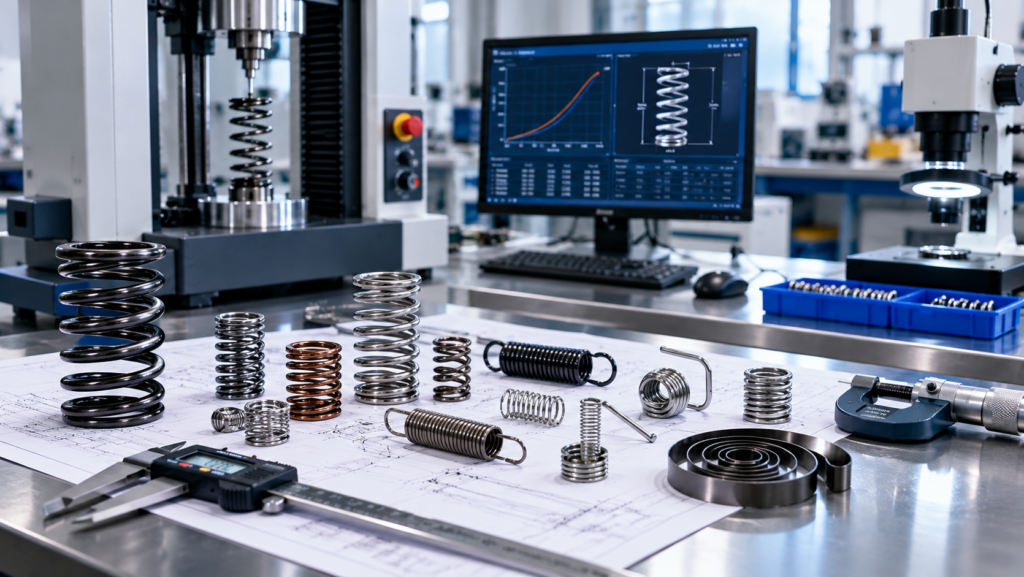
Automotive spring quality is rarely confirmed by visual inspection alone. A spring may look correct and still fail to deliver the required force, fatigue life, or dimensional stability in service. That is why buyers evaluating spring suppliers should understand the key tests behind product approval. The exact test plan depends on the spring type, but several quality checks appear again and again across automotive sourcing projects.
Force testing confirms functional output
Spring force testing is one of the most direct ways to verify whether a part can perform as expected. For compression springs, buyers usually focus on load at specific heights. For torsion springs, torque matters. For brush springs, controlled force output can be the central functional requirement.
A factory that can test force reliably is in a much better position to support repeat production. Without that capability, problems are often discovered too late, after assembly or service feedback. In B2B sourcing, that creates avoidable delay and higher correction cost.
Fatigue testing matters for repeated service cycles
Many automotive springs are expected to survive repeated motion over a long service life. Fatigue testing helps buyers understand whether a part can hold up under cyclical loading. This is especially relevant for applications such as shock absorber valve springs and other components where repeated movement is a normal operating condition.
A good fatigue test discussion should include the number of cycles, loading conditions, whether fracture occurs, and what happens to spring height or force afterward. A supplier that can explain those result points usually has a stronger quality mindset than one that only says the spring passed.
Hardness, tensile, and metallographic checks support root-cause control
Hardness testing, tensile verification, and metallographic analysis help reveal whether material and heat treatment are aligned with the product requirement. These checks are not always the main customer-facing test, but they are important when the factory needs to explain variation or investigate failure risk.
For example, when a spring shows unexpected performance change, the answer may not be a forming issue alone. Material condition or heat treatment response may be involved. A supplier with access to supporting tests can investigate that more effectively.
Dimensional inspection still matters
Functional tests do not replace dimensional checks. Profile projectors, spring testing machines, and controlled measurement points remain important because force problems can begin with shape or size drift. For flat springs and special-shaped wire parts, profile accuracy can be especially important.
The strongest quality systems do not treat these tests as separate islands. They connect material review, forming checks, force validation, and final inspection into one process.
Request a Quote from QIFENG SPRING if you need a spring supplier that can discuss force testing, fatigue review, material control, and batch-based inspection for automotive spring projects.
Request a Quote
Need production support for a spring component or custom drawing?
Contact QIFENG SPRING