
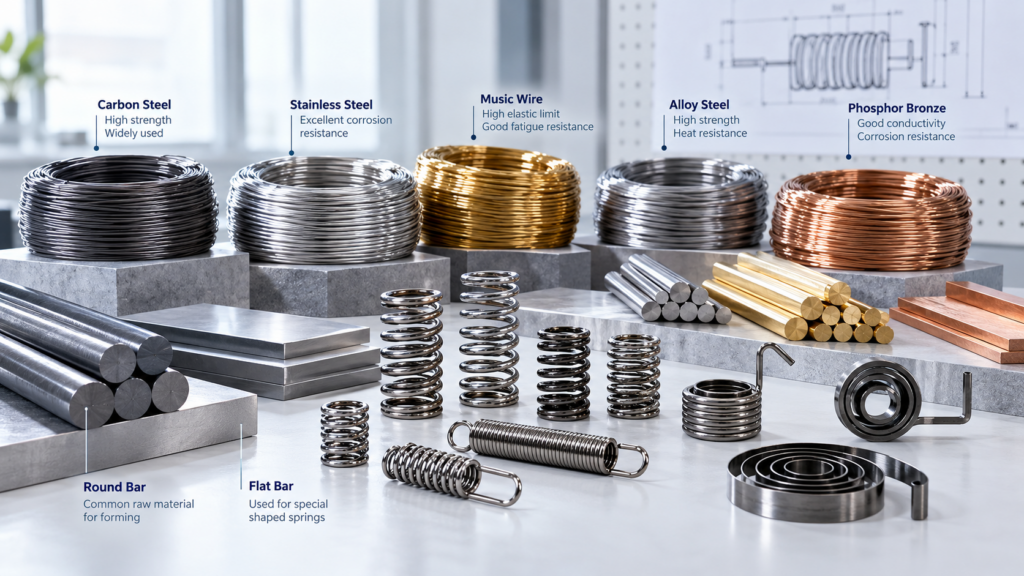
Material selection is one of the earliest and most important decisions in spring manufacturing. Even with the same drawing, changing the wire or strip source can influence forming behavior, force consistency, fatigue life, and corrosion performance. For B2B buyers, the goal is not only to choose a material name. It is to understand whether the selected material fits the application and whether the supplier can control it from incoming inspection onward.
Spring materials are chosen by application need
The right material depends on load, geometry, environment, and service expectation. Some spring programs need stable high carbon wire for repeat mechanical behavior. Others may require different material considerations because of exposure conditions or part geometry.
That is why good suppliers do not treat material choice as a checkbox. They connect it to application force, fatigue demand, corrosion exposure, and manufacturability.
Source consistency matters as much as material category
In precision spring manufacturing, the source of the material can be as important as the generic material description. Buyers often ask about the mills or brands used because consistent wire quality makes downstream forming and heat treatment more stable.
Factories that work with identified sources and incoming inspection routines are generally easier to qualify. This is especially helpful when a buyer wants to manage quality over repeated production lots instead of a one-time sample order.
Why certificates and batch records matter
Material certificates and batch management create traceability. If a performance issue appears later, the team can investigate whether the root cause may be related to raw material variation rather than only to forming or assembly.
Material and process must be reviewed together
A material that looks suitable on paper still needs to work with the chosen forming process and heat treatment route. Fine-wire brush springs, torsion springs, flat springs, and stamped spring parts may each respond differently to material and process choices.
That is why material discussion should happen alongside production process discussion. A supplier that can explain both is usually better prepared to support custom development.
What buyers should include in an RFQ
If you already know the preferred material, include it in the inquiry. If you are still comparing options, describe the application and environment so the manufacturer can advise. This helps avoid unrealistic quotations or preventable redesign later.
For many spring projects, the best result comes from combining drawing information with application context, target quantity, and inspection expectations.
Request a Quote from QIFENG SPRING if you need support reviewing material options, source control, and production fit for a precision spring project.
Request a Quote
Need production support for a spring component or custom drawing?
Contact QIFENG SPRING