
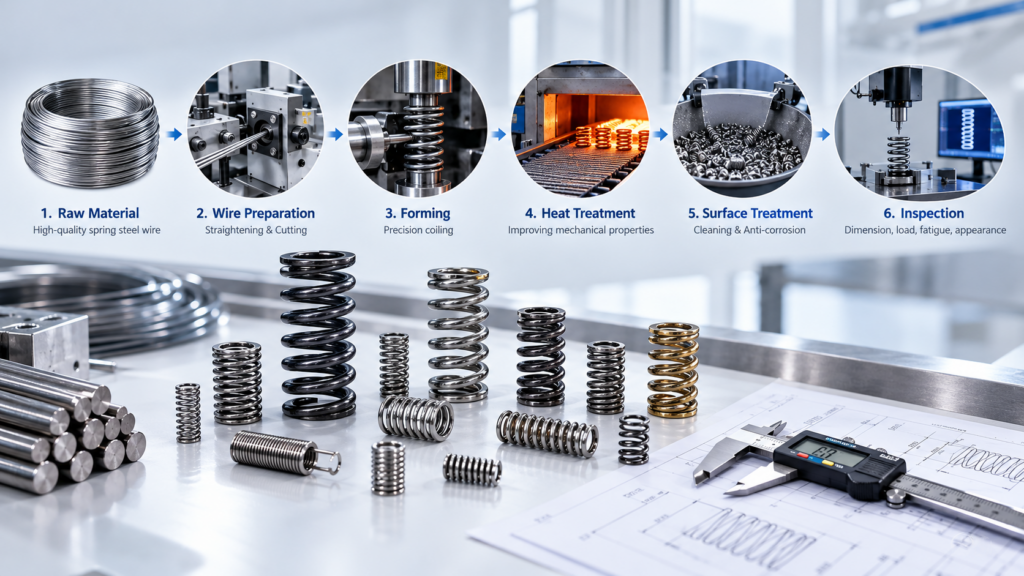
Compression spring sourcing is easier when buyers understand the production process behind the part. A spring is not defined only by its drawing dimensions. Its performance depends on material consistency, forming accuracy, heat treatment response, calibration, and inspection discipline. When a manufacturer can explain the full production route clearly, buyers have a much better basis for evaluating capability and quotation realism.
Raw material inspection sets the foundation
The production process starts with raw material inspection. This step checks whether the spring wire matches the required specification before it enters forming. In B2B projects, this is important because wire quality affects not only dimensional consistency but also force behavior and fatigue response.
A disciplined manufacturer should also manage material certificates and batch records. That makes it easier to trace variation if a problem appears later in the process.
Spring coiling and forming create the base geometry
After material approval, the wire moves into coiling or forming. At this point, machine capability, tooling condition, and operator control all influence the result. Even small shifts in forming can affect free height, pitch, and spring force.
For many buyers, this is where process discussions should become more specific. Ask how the factory monitors forming stability and how it reacts when the shape begins to drift during a run.
Why geometry alone is not enough
A spring that appears dimensionally close after forming may still need heat treatment and calibration before it is functionally ready. That is why experienced suppliers describe the next process stages in detail instead of treating forming as the end of the job.
Heat treatment, calibration, and secondary tempering
Heat treatment helps stabilize the spring after forming. Depending on the application and material, stress relieving, tempering, and calibration are used to improve performance consistency. Some product routes also include secondary tempering to reach the required balance of force and stability.
This part of the process is especially important for buyers who care about long-term repeatability. If heat treatment is not controlled, even a well-formed spring can behave inconsistently in service.
Surface treatment and final inspection complete the process
After heat treatment and calibration, springs may receive surface treatment based on the application environment. Final inspection then confirms whether the batch meets the drawing and performance expectations. Typical checks include force testing, dimensional review, appearance inspection, and packaging verification.
Good factories finish the process with batch management and shipment protection, not only with a final measurement. That helps maintain order accuracy and handling quality after production.
Request a Quote from QIFENG SPRING if you need compression spring manufacturing support with material review, forming discussion, and inspection-oriented quotation service.
Request a Quote
Need production support for a spring component or custom drawing?
Contact QIFENG SPRING