
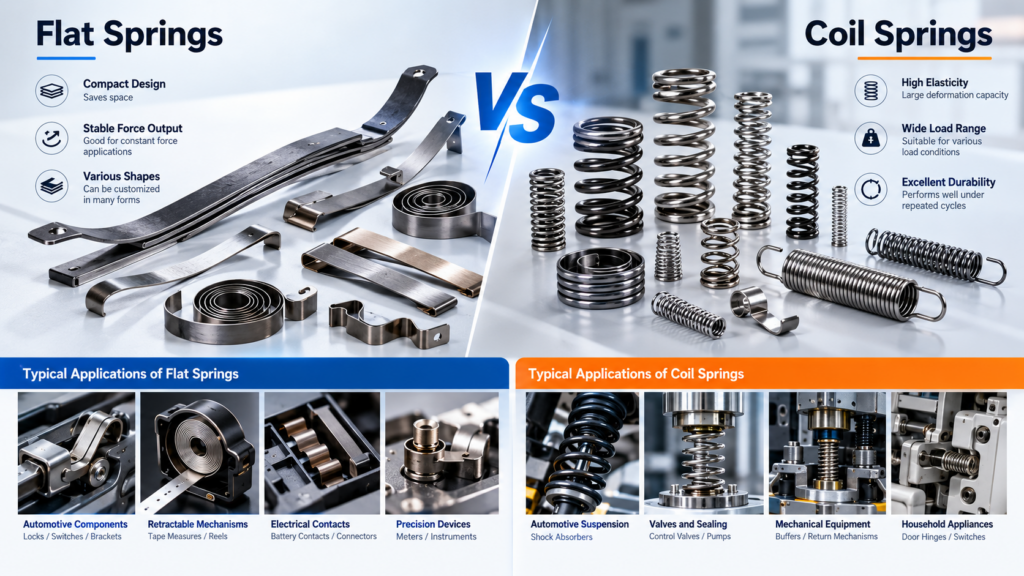
Flat springs and coil springs are both common in industrial and automotive products, but they are not interchangeable choices. Each spring form suits a different type of movement, space condition, and force requirement. Buyers who understand these differences can communicate more clearly with suppliers and reduce time spent exploring the wrong structure early in development.
The geometry drives the use case
Coil springs are often chosen when the design needs axial compression, extension, or torsion behavior in a compact circular form. Flat springs are more likely to be selected when the application needs profile-driven deflection, contact action, or a specific formed path within limited installation space.
Because the geometry is different, the way each spring stores and releases energy is also different. That is why the first question should be about function, not about which spring type is easier to manufacture.
Application discussion should focus on movement and space
When buyers compare flat springs and coil springs, they should describe how the part moves inside the assembly. Does it compress along an axis, pull back, rotate, or flex along a profile? Is the available space narrow, layered, or fixed by surrounding parts? Those answers often point quickly toward the correct spring family.
Flat spring projects may also need more attention to profile inspection and shape correction. Coil spring projects often place more emphasis on load, pitch, free height, and fatigue under repeated stroke.
Manufacturing and inspection priorities are different
A flat spring supplier should be ready to discuss forming accuracy, edge condition, shape stability, and heat treatment response for profile-based parts. A coil spring supplier should be ready to discuss coiling control, load testing, torsion or compression behavior, and the effect of heat treatment on force consistency.
This is important during sourcing because a factory may be strong in one category without being equally strong in the other. Buyers should therefore ask about product-family experience instead of assuming any spring manufacturer covers all formats with the same depth.
Use the inquiry stage to compare options
If your design is still open, a detailed inquiry can help you compare flat spring and coil spring routes before tooling or approval work goes too far. Share the function, available space, drawing or sample, and expected quantity. That gives the supplier enough context to recommend a realistic direction.
In many projects, choosing the right spring structure early saves more time than negotiating a low unit price on the wrong design.
Request a Quote from QIFENG SPRING if you need support comparing flat spring and coil spring options for a custom or automotive application.
Request a Quote
Need production support for a spring component or custom drawing?
Contact QIFENG SPRING