
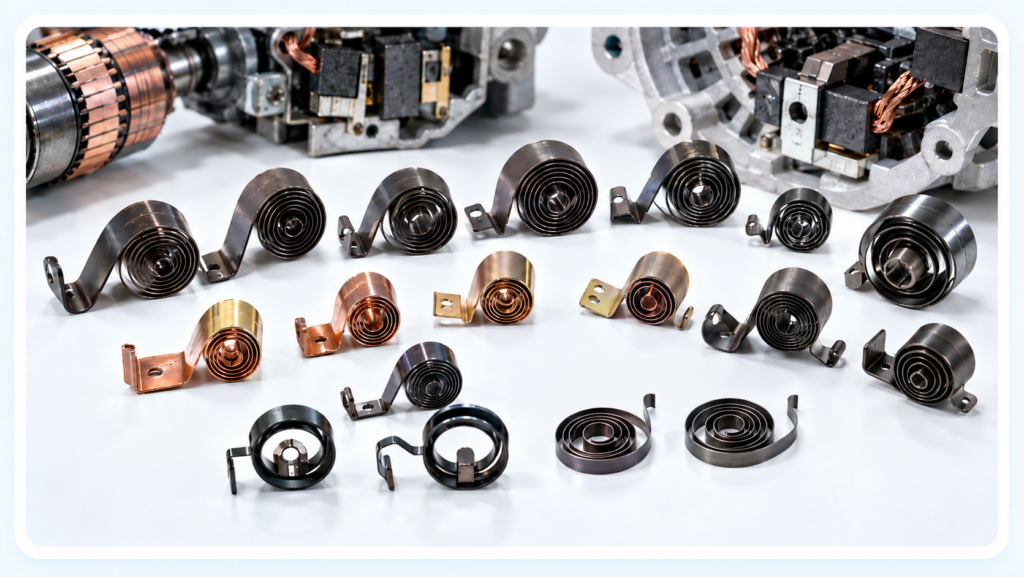
A carbon brush spring is a precision spring component used to maintain controlled contact pressure between a carbon brush and a moving electrical surface. In many assemblies, the spring itself is small, but its effect is significant. If the contact force is too low, performance can become unstable. If the force is too high, wear can increase. That is why buyers often treat brush spring sourcing as a performance issue rather than a simple hardware purchase.
What the spring actually does
The main role of a carbon brush spring is to keep the brush in proper contact while allowing movement as the assembly operates. The force must stay within a useful range through service vibration, movement, and repeated use. In practice, that means spring geometry, material quality, and heat treatment all influence the final result.
Because the spring is part of a dynamic contact system, dimensional accuracy alone is not enough. Buyers also need stable force output and good repeatability from batch to batch. That is why factories often use dedicated brush spring force testers when brush spring production is a core product family.
Common application areas
Carbon brush springs are commonly discussed in automobile and motorcycle starters and generators. In these applications, the spring must support electrical contact under operating movement and vibration. It also needs enough stability to avoid uneven behavior across assembled units.
Different end uses may call for different spring forms, wire sizes, and force targets. A spring used in one starter configuration may not transfer directly to another generator program without process or geometry changes. That is why inquiry discussions should include application description and expected performance, not only a part name.
How buyers should evaluate a brush spring supplier
When sourcing carbon brush springs, buyers should look for evidence of fine-wire forming ability, force testing capability, and repeatable process control. This product category usually depends on more precise forming and force verification than a general spring item.
Material source control also matters. If the wire quality changes, the spring may not hold the same force behavior after forming and heat treatment. A supplier that explains incoming inspection and batch management is usually easier to work with over longer production cycles.
Ask for the right quotation details
A strong RFQ should include product application, target quantity, drawing or sample, required force behavior, and any packaging or traceability expectation. This gives the manufacturer enough context to answer with more than a generic price.
Why this category deserves focused attention
Carbon brush springs are easy to underestimate because of their size. However, small spring parts can still drive assembly quality and service stability. That is especially true when the spring influences contact pressure inside an electrical or rotating system.
For that reason, buyers should treat brush springs as engineered components. Process control, force testing, and clear communication are all part of a good sourcing decision.
Request a Quote from QIFENG SPRING if you are comparing starter or generator brush spring suppliers and need support for drawing review, force discussion, or sample development.
Request a Quote
Need production support for a spring component or custom drawing?
Contact QIFENG SPRING