
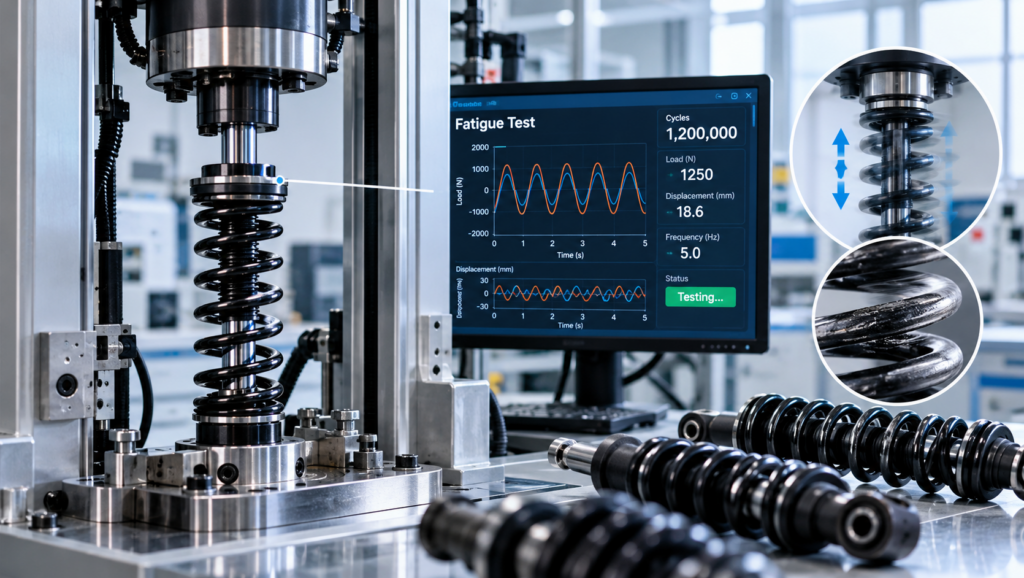
Shock absorber spring applications are closely linked to repeated movement. That makes fatigue testing one of the most important tools in supplier evaluation and product approval. Without fatigue review, a spring may appear acceptable at the sample stage but fail to hold up when exposed to long-cycle service conditions. Buyers working on valve springs and similar dynamic parts should therefore pay close attention to how a supplier approaches life testing.
Dynamic applications need more than initial force checks
Initial force testing tells you how the spring behaves at a defined measurement point. That is necessary, but it is not enough for a spring that must survive repeated action. A shock absorber spring may start within specification and still drift, deform, or fracture over time if fatigue performance is weak.
That is why long-cycle testing is valuable. It shows how the spring behaves under repeated loading that is closer to real use.
Useful fatigue evaluation includes more than pass or fail
A buyer should not be satisfied with a simple statement that a spring passed a fatigue test. More useful reporting includes cycle count, whether fracture occurred, and what happened to height loss or force loss after the test. Those details help engineering teams understand actual performance reserve.
For example, when a test case reports that a spring reached 10,000,000 cycles without fatigue fracture, that is a meaningful start. The next question is how much force or height changed and whether that change remains acceptable for the application.
Test equipment and measurement discipline influence confidence
Fatigue data is only useful if the measurement method is credible. Buyers should ask what equipment was used, how parts were measured before and after cycling, and whether profile or dimensional review was part of the evaluation. Compression testing machines, fatigue testing machines, and profile projectors can each play a role in building a full picture.
A supplier that can explain both the test and the follow-up measurements usually inspires more confidence than one that only shares a headline result.
Why this matters during sourcing
Fatigue testing helps reduce sourcing risk because it connects the manufacturing process to actual service expectations. If the spring will operate in a dynamic system, long-cycle behavior should influence supplier choice, process approval, and production monitoring.
For buyers, fatigue testing is also a useful communication tool. It helps align engineering, purchasing, and quality teams around evidence rather than assumption.
Request a Quote from QIFENG SPRING if you need support for spring projects where fatigue life, force retention, and post-cycle evaluation are part of the qualification process.
Request a Quote
Need production support for a spring component or custom drawing?
Contact QIFENG SPRING