
Yes. Henan Qifeng Spring Co., Ltd. supports OEM and ODM production from complete technical drawings, physical samples, or a combination of both. A drawing is preferred because it defines dimensions, tolerances, material, finish, and load requirements clearly. When only a sample is available, our team can review its geometry and discuss the working condition before preparing a quotation. Reverse engineering cannot confirm hidden material properties or original fatigue targets from appearance alone, so customers should also provide the application, installed dimensions, operating movement, expected service life, and estimated quantity whenever possible.
Engineering Knowledge Base
Spring Manufacturing FAQ & Technical Support
Find answers about custom spring design, materials, manufacturing processes, quality testing, sampling, and international orders.
- Drawing or sample review
- 100 pcs typical MOQ
- 3–7 day typical sampling
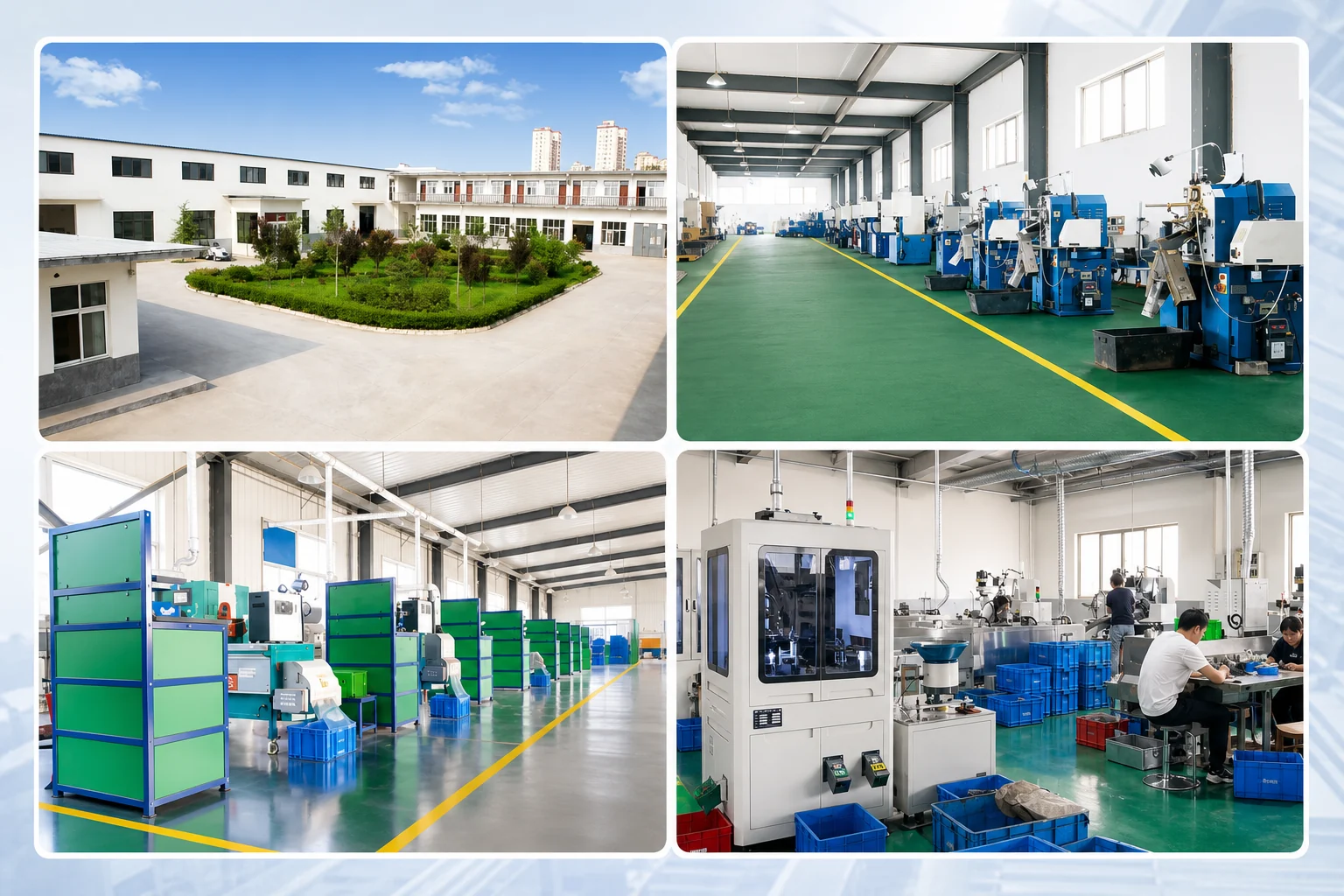
24technical answers
Browse by Topic
Technical answers for spring sourcing and production
Select a category to move directly to the questions most relevant to your project.
Technical FAQ
Custom Spring Design & Engineering
Drawing review, reverse engineering, design optimization, and replacement spring development.
For an accurate quotation, please provide the spring type, technical drawing or sample, wire diameter or strip thickness, main dimensions, material grade, surface treatment, load or spring-rate points, working travel, tolerance requirements, estimated order quantity, and delivery destination. For torsion springs, include working angle and leg orientation; for extension springs, include hook details and initial tension; for compression springs, include end style and installed height. Missing technical conditions may require assumptions, which can affect price and manufacturability. Our engineering team will identify the remaining questions before confirming the quotation.
We can review a customer design for practical manufacturing issues such as material availability, coil geometry, end configuration, forming access, stress concentration, tolerance priorities, and inspection method. Recommendations are based on the information supplied and must be evaluated against the customer’s actual assembly and performance requirements. We do not replace the customer’s product validation or safety approval process. To support a useful review, send the drawing, application description, mating-part constraints, load or torque targets, working cycle, environment, failure history if applicable, and expected production volume.
Replacement and discontinued springs can be evaluated from an existing drawing, an unused reference sample, or a serviceable part together with its assembly conditions. Used springs may have permanent set, wear, corrosion, or force loss, so copying their current dimensions alone may not reproduce the original function. We recommend providing the installed space, required load or torque, operating travel, material information, and any available historical specification. Sampling and functional validation are normally required before batch production. Contact our engineering team when the part is safety-related or when no reliable original specification remains.
Technical FAQ
Spring Materials & Surface Treatments
Material selection, heat treatment, corrosion protection, and specification review.
Common options include high-carbon spring wire, music wire, stainless spring wire, alloy or oil-tempered wire, and spring steel strip for flat or stamped parts. Material selection depends on required force, stress level, fatigue life, working temperature, corrosion exposure, electrical requirements, forming complexity, and cost. A familiar grade is not automatically suitable for every application. Please provide the specified grade, applicable material standard, wire diameter or strip thickness, operating environment, and performance targets. We will review availability and process compatibility before confirming the material for quotation or sampling.
A technically comparable grade may be considered when the specified material is unavailable or commercially impractical, but substitution requires customer approval. Similar names across GB, ASTM, EN, JIS, or other standards do not guarantee identical chemistry, tensile range, heat-treatment response, corrosion resistance, or fatigue performance. We can compare available specifications and explain the proposed manufacturing impact, while the customer remains responsible for approving the change for the final application. Please provide the original standard, grade, condition, critical properties, regulatory restrictions, and whether a material certificate or sample validation is required.
No. The correct thermal process depends on the starting material, forming method, part geometry, and required properties. Some pre-hardened spring wires are formed and then stress-relieved, while certain strip or alloy components may require hardening and tempering after forming. Excessive or unsuitable heat treatment can change dimensions, surface condition, or mechanical performance. The process must therefore be selected together with the material specification and application requirements. Please share the drawing, material condition, hardness requirement if any, working load, temperature, and fatigue expectation so the production route can be reviewed correctly.
Surface treatment is selected according to corrosion exposure, friction, appearance, conductivity, hydrogen-embrittlement risk, and customer standards. Depending on the spring material and specification, projects may be reviewed for options such as oil protection, blackening, phosphating, zinc-based coatings, passivation, plating, or other customer-defined finishes. Not every treatment is suitable for every high-strength spring, and coating thickness can affect dimensions or spring behavior. Send the required finish standard, color, salt-spray or corrosion expectation, restricted-substance requirement, masking areas, and mating conditions for process confirmation and quotation.
Technical FAQ
Quality Control & Performance Testing
Dimensional inspection, force verification, fatigue evaluation, and documentation.
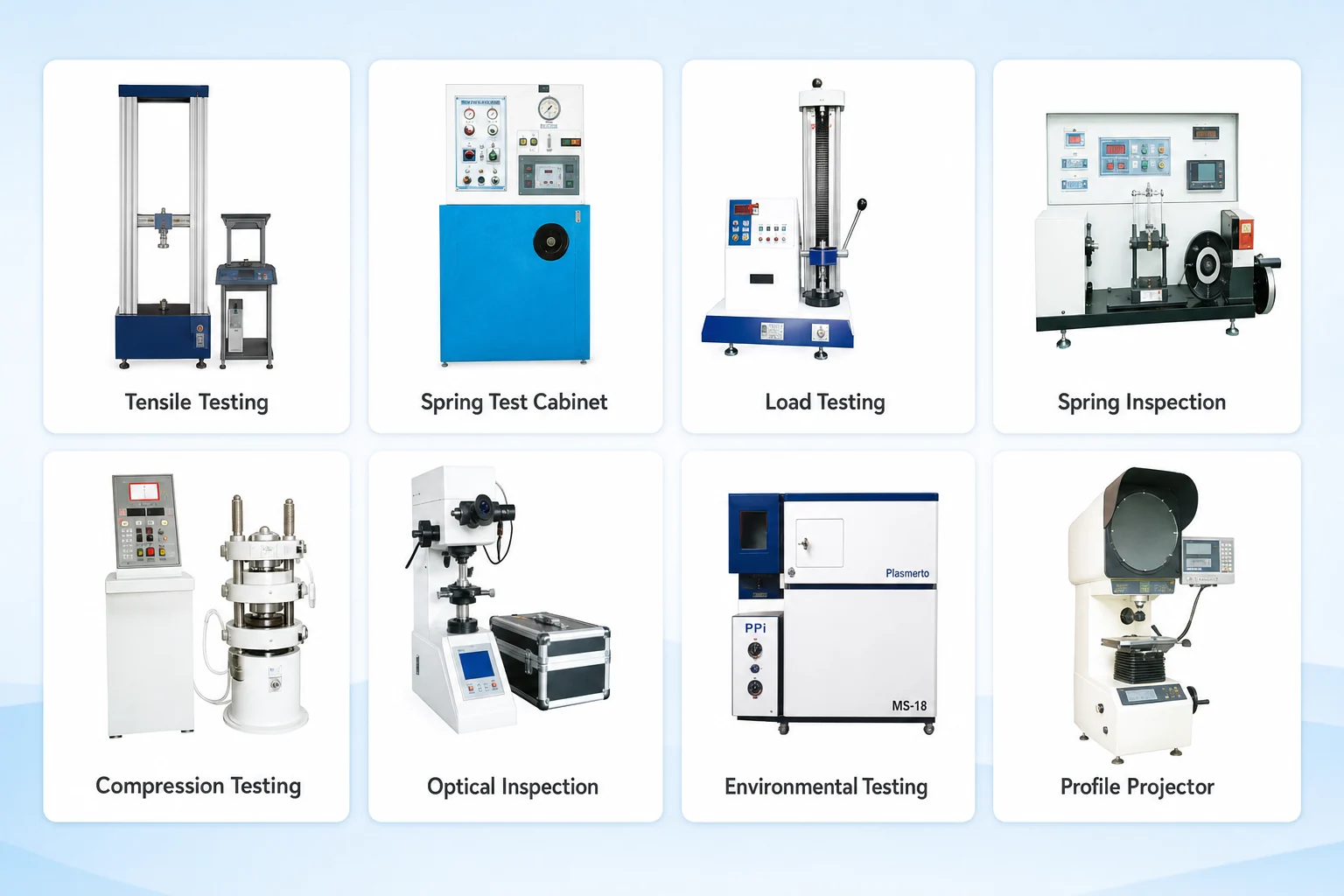
Inspection planning is based on the drawing, spring type, production process, and critical application characteristics. Typical checks can include wire or strip size, free length, coil diameter, pitch, end geometry, leg angle, flatness, appearance, and load or torque at defined positions. Some characteristics require dedicated gauges or agreed measurement fixtures because spring geometry changes under load. Please identify critical dimensions, tolerance standards, measurement condition, sampling level, reporting format, and any mating-part checks before quotation. Final acceptance criteria should be agreed before sample approval and mass production.
Spring force, torque, or spring rate can be evaluated when the measurement condition is clearly defined and suitable equipment or fixtures are available for the part. Compression springs normally require specified test heights; extension springs may require initial tension and load at defined lengths; torsion springs require torque at stated angles. Spring rate calculated from two load points can differ from a single nominal value. Please provide the test positions, preload method, speed if relevant, tolerance, sample quantity, and any fixture or installation reference. The confirmed test method will be included in the technical review.
Fatigue testing can be reviewed for projects with defined cycling conditions, fixture requirements, and acceptance criteria. A meaningful test requires minimum and maximum working positions or loads, frequency, target cycle count, temperature or environment, sample quantity, and the permitted changes in height, force, torque, appearance, or fracture condition. Test capability and schedule depend on spring geometry, load range, fixture preparation, and current laboratory capacity. Fatigue results apply to the tested samples and conditions; they do not replace complete validation in the customer’s final assembly. Please discuss the test plan before sample production.
Inspection records and available material documentation can be provided when these deliverables are specified before order confirmation. The exact format and scope depend on the product, supplier documentation, inspection plan, and customer requirements. Options may include dimensional or load results, sample approval records, lot identification, and material certificates available for the purchased batch. Third-party testing or special report formats may add cost and lead time. Please send the required document list, language, standard, traceability level, and submission timing with the RFQ so feasibility can be confirmed rather than assumed after production.
Technical FAQ
Sampling, MOQ & Production
Prototype planning, MOQ, tooling, lead time, and repeat production.
The typical minimum order quantity is 100 pieces per specification. The practical MOQ may change with wire or strip purchasing requirements, tooling, heat treatment, surface finishing, inspection workload, packaging, and part size. Multiple similar specifications cannot always be combined because material, setup, and traceability may differ. For development projects, we can separately review a smaller sample quantity before mass production. Please provide the drawing, required sample quantity, expected production quantity, annual demand, and forecast frequency so the most economical sampling and production arrangement can be evaluated.
Sample production is typically 3–7 days after technical requirements, material, tooling approach, quantity, and commercial terms are confirmed. Actual timing depends on material availability, spring complexity, special tooling, heat treatment, surface finishing, testing, and the current production schedule. The lead time starts after open technical questions are resolved, not simply when an inquiry is received. Complex tooling, external finishes, or special reports may require additional time. Send a complete drawing, sample needs, validation plan, and requested delivery date so we can provide a project-specific schedule.
Mass production lead time is approximately 20 days for many standard custom spring projects, but this is a planning reference rather than a fixed guarantee. Actual timing depends on material procurement, order quantity, tooling status, technical complexity, heat treatment, surface finishing, inspection requirements, packaging, and the production schedule at order confirmation. Lead time should be reconfirmed after sample approval and before each purchase order. For recurring demand, please share monthly forecasts, batch sizes, requested delivery windows, and any safety-stock expectations so production and material planning can be discussed.
Sample fees may be required to cover material preparation, machine setup, engineering review, tooling, special fixtures, surface treatment, testing, and international delivery. The amount depends on the design and cannot be determined from quantity alone. Whether any fee can be credited against a later production order must be agreed in the quotation; it should not be assumed automatically. Please provide the drawing, sample quantity, required reports, delivery address, and expected mass-production volume. We will separate sample, tooling, testing, and freight costs where applicable so the development scope is clear.
Technical FAQ
International Orders & Logistics
Export orders, payment, packaging, documentation, and recurring supply planning.
Yes. Henan Qifeng Spring Co., Ltd. supports international inquiries for custom compression springs, extension springs, torsion springs, flat springs, spiral springs, constant force springs, retaining rings, and custom wire forms. Export feasibility depends on product specifications, order value, destination, packaging, transport restrictions, and agreed trade terms. Customers should provide the destination country and postal code, preferred shipping method, importer requirements, delivery deadline, and whether samples and production orders will use different logistics. Duties, taxes, customs clearance, and destination compliance should be clarified with the buyer or appointed logistics provider.
The standard reference term is 50% advance payment and 50% before shipment, unless otherwise agreed in the formal quotation or sales contract. Terms may vary according to tooling, sample work, order value, production risk, customer history, and project duration. Bank charges, currency, payment milestones, and the conditions for starting material procurement should be confirmed before payment. Do not rely on website text alone for a transaction; use the beneficiary and account details shown on the current official invoice and verify any requested account change directly with our known company contact.
Export packaging and standard shipment documentation can be arranged according to the confirmed order and destination requirements. Packaging may include part separation, anti-deformation protection, moisture or corrosion protection, labels, inner cartons, and outer cartons or other agreed methods. Exact documents depend on the shipment and trade arrangement and may include a commercial invoice, packing list, and transport documents. Special certificates, fumigation requirements, country-of-origin documents, or customer-specific labels must be requested before order confirmation because they can affect cost and lead time. Please send the destination and documentation checklist with the RFQ.
Recurring monthly supply can be reviewed after the specification, sample approval, quality requirements, forecast, and commercial terms are stable. Planning is more reliable when the customer provides an annual estimate, rolling forecast, monthly call-off quantity, target inventory, packaging standard, and required delivery window. Material lead time and minimum purchasing quantities may influence batch size. Forecasts are not automatically treated as firm purchase orders unless agreed contractually. For long-term programs, we recommend defining change control, revision management, lot traceability, inspection records, and the process for handling urgent demand before regular shipments begin.
Technical FAQ
Automotive Applications & Supplier Qualification
Application review, batch consistency, supplier audits, and long-term programs.
We review custom spring projects for automotive and related electromechanical assemblies, including applications involving compression, return, torsion, brush-pressure, valve, retaining, flat, and formed-wire functions. Suitability must be evaluated from the specific drawing and operating condition rather than a general product name. Please provide the assembly function, installed space, force or torque points, movement, temperature, corrosion exposure, vibration, target life, safety or regulatory classification, and annual demand. Safety-critical projects require clear validation responsibilities and customer-approved specifications before production. Contact our engineering team for an application-specific review.
Batch consistency starts with an approved specification, controlled material and process route, machine setup records, defined inspection points, and traceable lot identification. Critical dimensions and performance checks should be agreed during sampling so the same measurement method is used in production. Changes to drawings, material, tooling, heat treatment, surface treatment, or inspection criteria require review before implementation. The exact control plan depends on product risk and customer requirements. Please identify special characteristics, sampling frequency, report needs, packaging controls, and traceability expectations in the RFQ or supplier-quality documentation.
We can support reasonable supplier-review requests by providing available company, process, quality, material-control, inspection, and project information relevant to the proposed spring program. The scope must be agreed because customer questionnaires, remote reviews, on-site audits, sample submissions, and special documentation can require different preparation. Certification claims and compliance documents should be verified against current official records rather than assumed from marketing text. Please send the supplier manual, audit checklist, required documents, confidentiality conditions, target schedule, and the part family under review so we can confirm what can be provided.
Long-term supply agreements can be discussed for programs with stable specifications, validated samples, realistic forecasts, agreed quality criteria, and clear commercial responsibilities. Important topics include pricing review, material-index changes, forecast and firm-order windows, capacity planning, tooling ownership and maintenance, revision control, inventory expectations, delivery performance, packaging, traceability, and handling of obsolete stock after engineering changes. Agreement terms depend on project volume, risk, and duration. Please provide the expected annual demand, program lifetime, monthly schedule, service requirements, and proposed contract terms for a structured commercial and technical review.
RFQ Preparation
What Information Should You Send for a Spring Quotation?
A complete RFQ helps engineering review the correct material, process, tooling, inspection method, and production plan without avoidable clarification rounds.
Submit Your Spring Requirements- Technical Drawing or Sample
- Spring Type
- Wire Diameter / Strip Thickness
- Material Grade
- Main Dimensions
- Load or Spring Rate Requirements
- Surface Treatment
- Estimated Order Quantity
- Delivery Destination
Engineering Library
Explore Our Technical Resources
Continue with practical guides on spring production, materials, CNC forming, and quality verification.
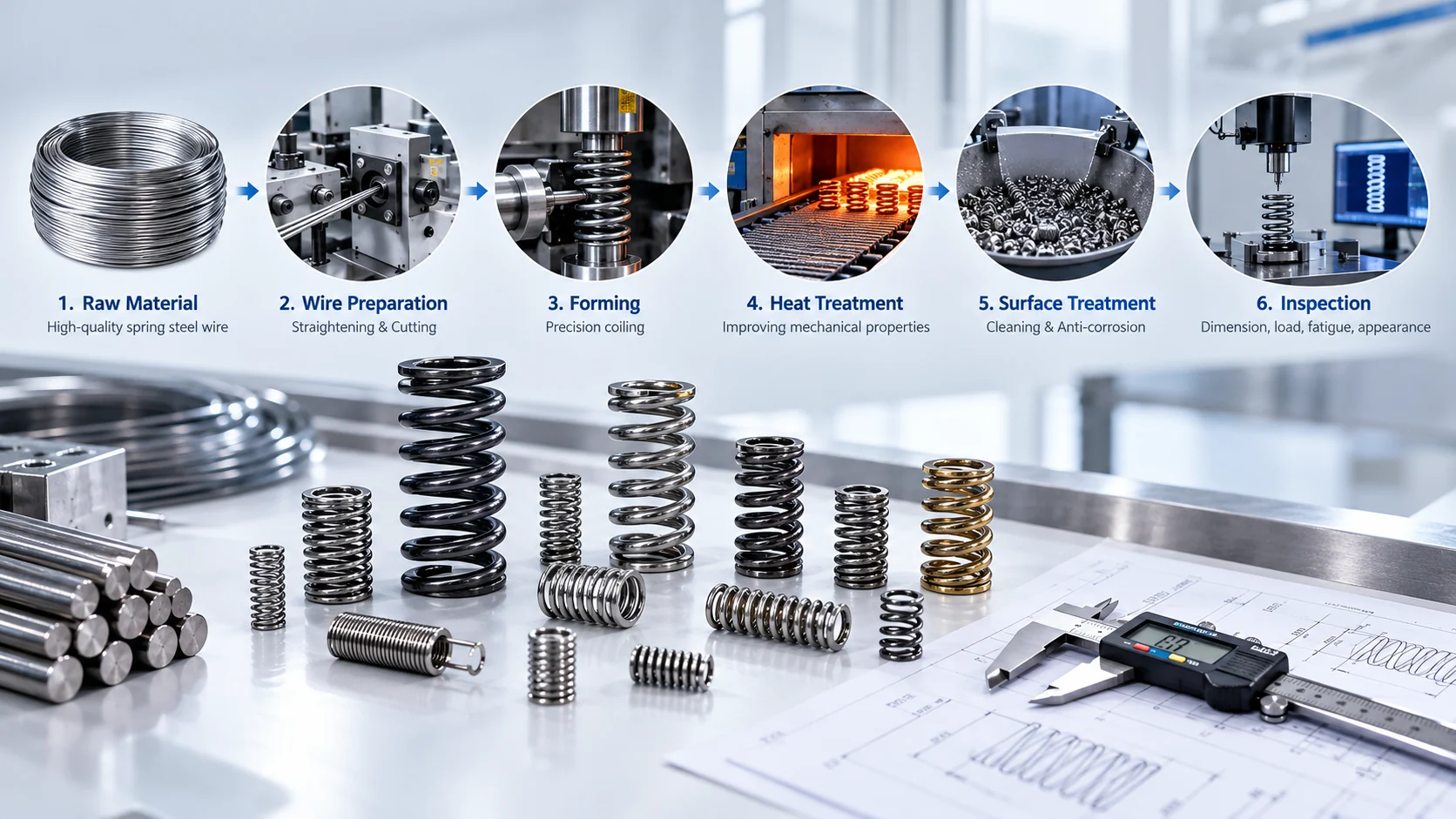
Technical Article
Compression Spring Production Process
Follow the manufacturing route from wire preparation and forming through heat treatment and final inspection.
Read More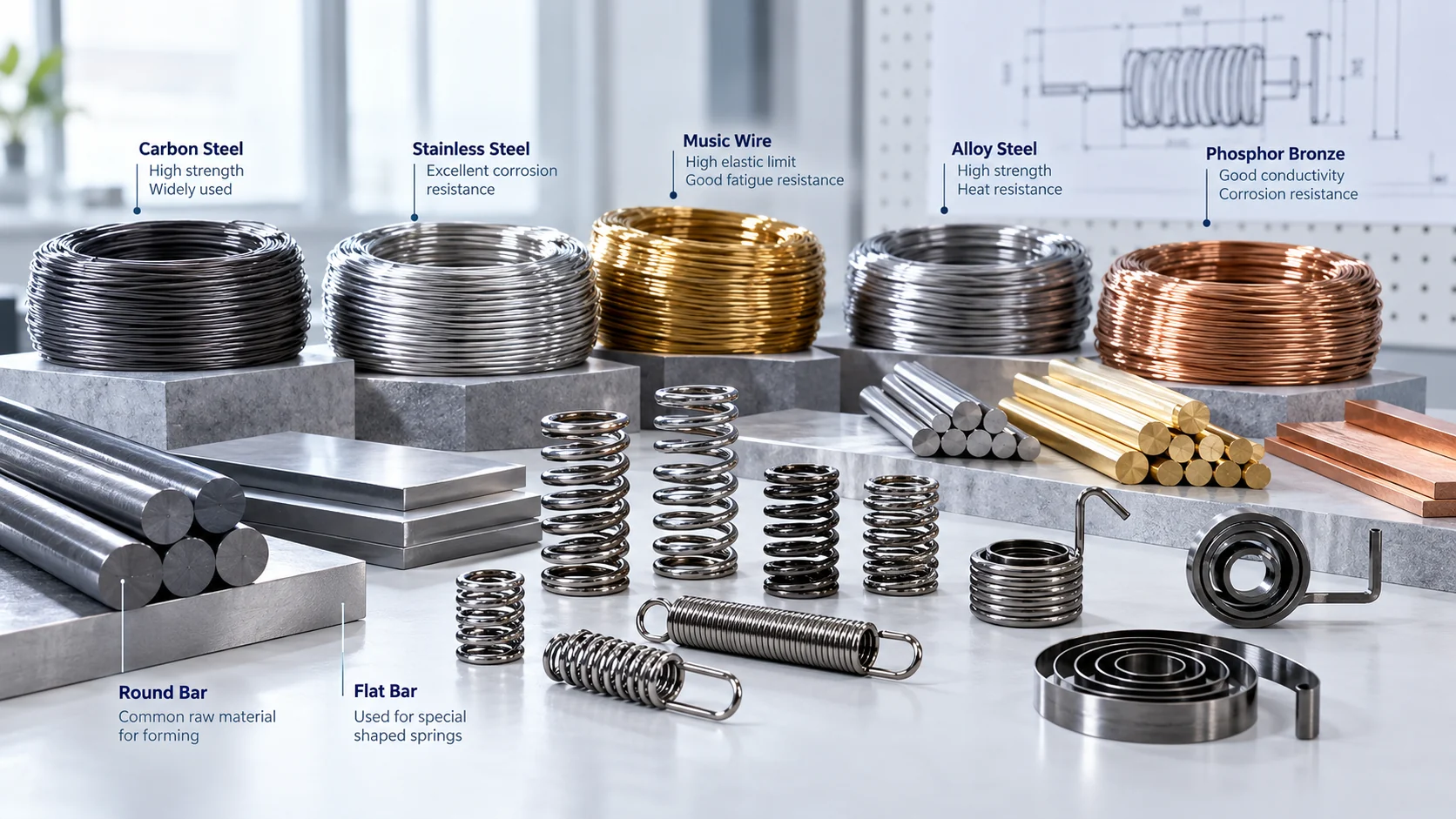
Technical Article
Common Materials Used in Precision Spring Manufacturing
Compare common spring materials and the application factors that guide material selection.
Read More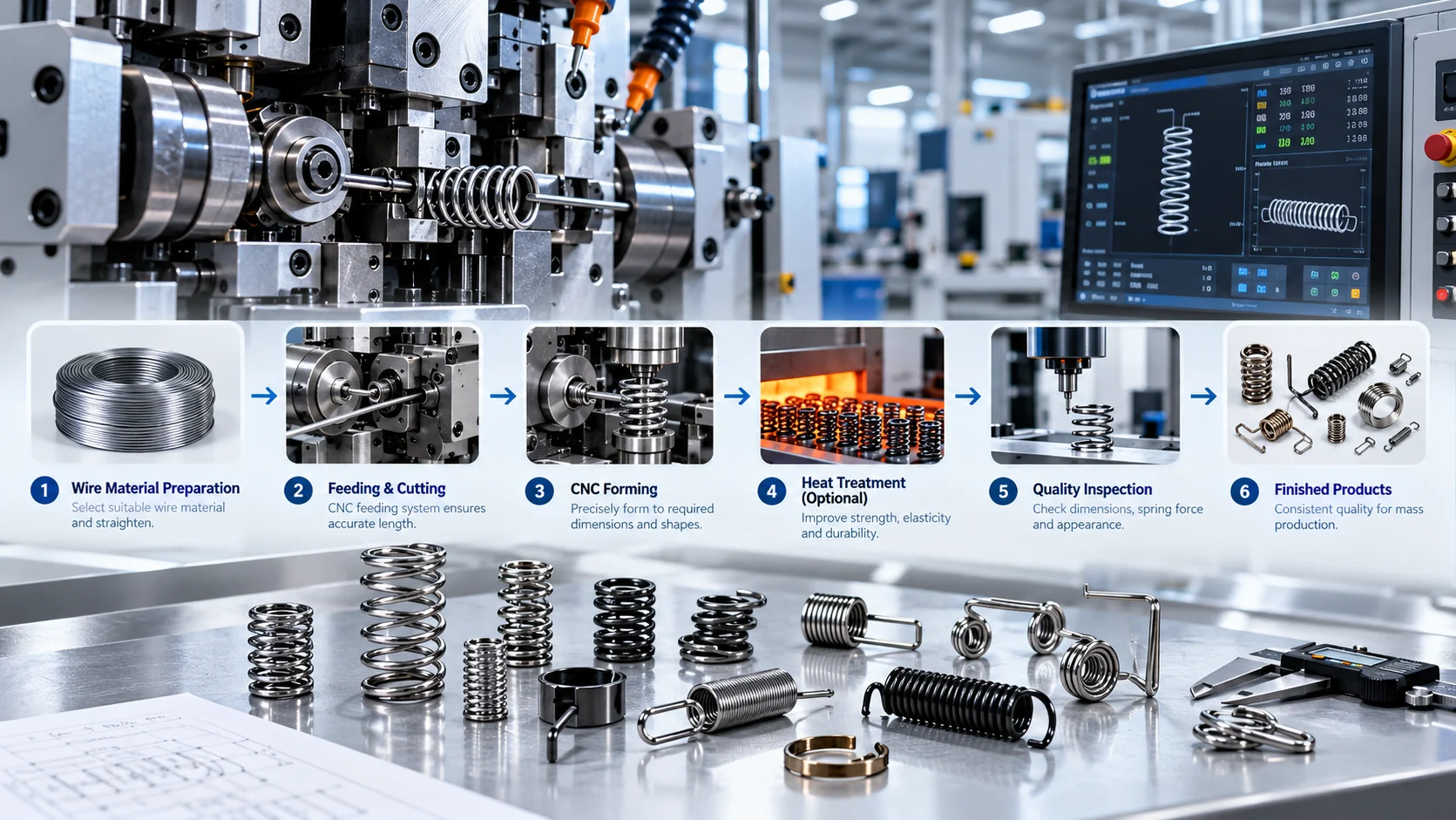
Technical Article
How CNC Spring Forming Improves Product Consistency
See how controlled feeding, forming, heat treatment, and inspection support repeatable production.
Read More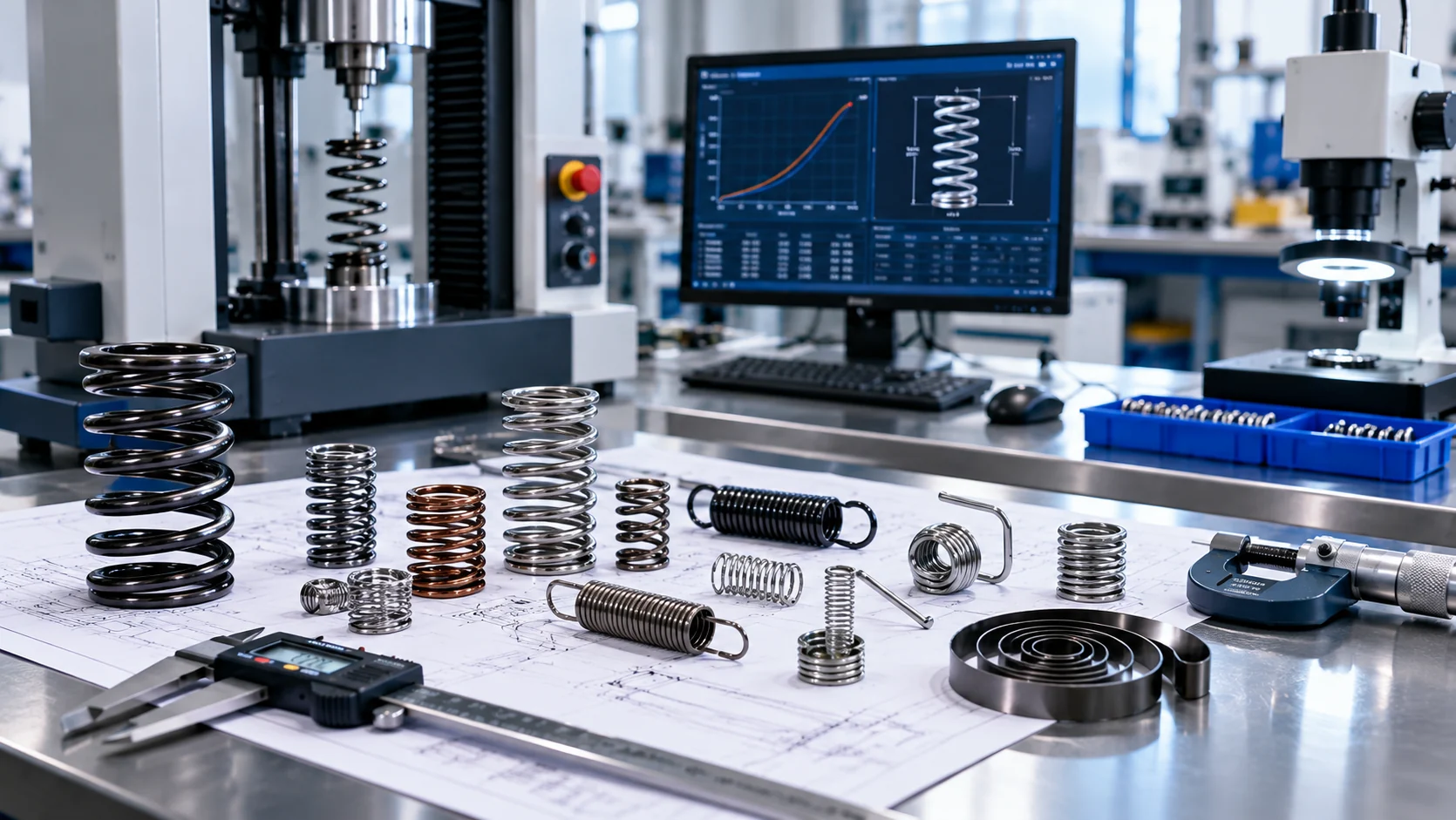
Technical Article
Key Quality Tests for Automotive Springs
Review dimensional, force, hardness, torsion, fatigue, corrosion, and material inspection topics.
Read MoreEngineering Support
Still Have Questions About Your Spring Project?
Our team can review your drawings, material requirements, application details, and estimated order quantities to help evaluate your custom spring project.